Tuesday, March 29, 2011

Bringing the Pilgrims to Qom


March 25, 2011 | Maryam Eskandari

featured in PBS|Frontline - Tehran Bureau


Islamic Republic's push to develop Shia holy city as a top Middle Eastern destination.

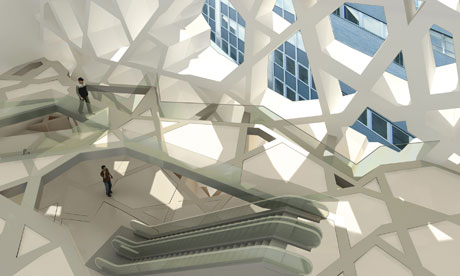
[ dispatch ] Since the early 16th century, during the Safavid dynasty, the holy city of Qom has been a significant center of Shia theological education and a locus of pilgrimage. Recently, its development has become a top priority for the Islamic Republic of Iran. Over the past eight years, Iran has been expanding Qom, not only as an "Islamic Education Center," in competition with other such cities such as Najaf, Iraq, but with the goal of making it one of the major destinations in the Middle East.

After the late 1700s, when the city flourished as a center of religious learning under Agha Mohammad Khan Qajar, little attention was paid to its development for more than century. However, in 1915, when invading Russian forces entered the nearby city of Karaj, many residents of Tehran province moved to Qom, spurring its growth into one of the region's major metropolitan areas. Consideration was even given to shifting the Iranian capital from Tehran to Qom. Over the past six years, under President Mahmoud Ahmadinejad, a vast amount of development money has been flowing into the city.

Thursday, March 17, 2011

Gender, Sexuality and Urban Spaces


This was a great, if in cohesive group of panelists. They’ve each done really interesting research on different architectural expressions of ‘women’s spaces’ in three different US institutions: contemporary Mosques, Gymnasiums at the turn of the century, and Settlement Houses in the early 1900′s.

Maryam Eskandari gave a very compelling presentation on the need to re-examine mosque typology and explore the gender hierarchy assumptions embedded in that typology. Essentially, her work has determined that mosques prioritize men’s space, making the front of the mosque inaccessible to women, and allocating the separate women’s prayer space as ½ to 1/5 the amount of space allocated to the men. She talked about radical activists in the US staging Rosa Parks-style interventions in this model. And, she advocated for the role of architects in changing the typology, making contemporary mosque design reflect the changing politics of the practice of Islam in the US where communities are more open to mixed gender prayer spaces.

read more @ Plural Titanium

follow the conference @ Gender, Sexuality and Urban Space

Libya’s Architecture on the Brink


March 7, 2011 | Maryam Eskandari

featured in NYC Elan magazine

In the past couple of years, Libya has been on the forefront on cutting edge architecture. Competing with other Middle Eastern countries, such as Kingdom of Saudi Arabia, Kuwait and Qatar, Libya has been able to keep up with the “architecture boom” that has been on the rise in that region. However, several days ago, when the Security Council of the United Nation slapped a 15-0 vote sanctions on Libya in hopes to send a strong message to Libyan leader Moammar Gadhafi; many of the architectural firms stepped up to support the United Nation decision. The international firms that have on-going projects have all vowed that they would never work in Libya, under Gaddafi’s regime and have suspended all projects.

Read more

Tuesday, March 01, 2011

Tahrir Square: Social Media, Public Space: Places: Design Observer

The Mubarak government extended a series of policies initiated under Anwar Sadat. The regime supported laws and actions that sharply limited Egyptians’ access to public space — to places where citizens could congregate, meet, talk, interact. It promoted the development of gated communities with private parks, golf courses and luxury shopping malls, and in doing so facilitated the exodus of Cairo’s middle and upper classes into the desert at the city's periphery. At the same time the government ignored the city's center; its ongoing mismanagement of housing development has resulted in the extensive zone of informal housing, mostly unfinished brick shanties, that rings Cairo. And Mubarek worked to effectively dismantle and depopulate Cairo’s much-admired public squares and parks, including not just Tahrir Square but also Ramses Square and Azbakiyya Gardens. For decades, in fact, public policy and urban planning, like most governmental matters, were filtered through the harsh lens of state security. Urban open spaces — anywhere citizens might congregate and stage political demonstrations — were systematically subdivided or fenced off or given over to vehicular traffic and flyovers, and thus made challenging and even scary for pedestrians. Collectively such policies have led not only to the decline of public space but also to the inexorable deterioration of cities and the erosion of civic pride.


Read more : Tahrir Square: Social Media, Public Space: Places: Design Observer

Sunday, February 20, 2011

intellectual design means focus...: SACRED SPACE??

intellectual design means focus...: SACRED SPACE??

SACRED SPACE??


read more at PBS | Frontline

Sacred Space: (Re)Constructing the Place of Gender in the Space of Religion
A Photographic Installation by Maryam Eskandari, American Iranian Architect | Artist
Opening reception: February 17, 2011, 5:30-7:30pm

On view: February 1-March 21, 2011

With 6 million observant Muslims residing in the United States, there is an ever-present demand for construction of mosques in U.S. cities. The architectural design of community mosques in the U.S. emerges as a particularly understudied problem in the aforementioned encounter between Middle Eastern architecture and American religious practice. Numerous case studies and investigations of a diverse set of mosques were conducted and studied, indicating an overwhelming majority of diverse Muslim communities across the U.S., articulating the ideal space between a “Modern Mosque” versus a “Traditional Mosque.”

All images are now part of the the Aga Khan Visual Archive.

Sponsored by: The Aga Khan Program in Islamic Architecture, Harvard and MIT Libraries, School of Architecture + Planning.

Sunday, January 23, 2011

Gehry Design Plays Fanfare for the Common Man


published in NY Times |
By NICOLAI OUROUSSOFF

MIAMI BEACH — Can an architect save classical music? That seems to be what Michael Tilson Thomas, the artistic director of the New World Symphony, was counting on when he hired Frank Gehry to design him a new music center. Like others running classical music institutions today, Mr. Thomas is struggling to connect to a younger audience. The 81-year-old Mr. Gehry, who used to baby-sit for Mr. Thomas, 66, when both were living in Los Angeles, built his reputation as an architect with a knack for tapping into the popular imagination.

Read more

Monday, January 10, 2011

MIT and the art of innovation


Jan 9th 2011, 20:42 by P.M. | CAMBRIDGE, MASSACHUSETTS


WHAT is the secret of innovation? There are many explanations. “You start with some very bright people, let them hang out with other very bright people and allow their imaginations to roam,” is how Susan Hockfield, the president of the Massachusetts Institute of Technology (MIT), sums it up. But there seems to be an important local factor too.


Babbage has been along to an exhibition which has just opened at the MIT museum as part of the celebration of the institute’s 150th anniversary. Staff, students and others were asked to help pick the 150 artefacts that have been included. The idea is that these things illustrate not just some of the breakthroughs MIT has been involved with, but also the character of the institute. Some 700 nominations were made to a website and these were voted on.

read more

Monday, January 03, 2011

2010: The Year of Contentious Architecture


December 28, 2010 | Maryam Eskandari

Featured in New York's Elan Magazine

In 2010, this year’s headlines showcased architectural projects pushing the envelope. Plagued with debate, below are the top five most controversial buildings this year.

On top of the list was none other than the Burj Dubai, renamed Burj Khalifa honoring the ruler of Abu Dhabi who spared $11 billion dollars to rescue Dubai from its financial crises. The 2,717 feet tower designed by the Chicago office of Skidmore, Owings, and Merrill (SOM) LLP, were determined to build the world’s tallest, sustainable, mixed use, and free standing structure that ever existed. On the 158th level is the world’s highest mosque, while the world’s highest swimming pool resides on the 76th floor. With barely 900 apartments now owned and only three-quarters of the 37 floors of commercial and office spaces occupied, Dubai still struggles with the rest of the $29 billion tab for the Burj. Nevertheless, what is unfortunate to see was the one-week opening of the observation deck that was forced closed because of liability and safety issues. The Burj Khalifa is still struggling to make a name for itself, while the main architects: Adrian Smith and Gordon Gill who where the designers of the Burj, upon completion, where immediately hired by the Kingdom of Saudi Arabia to design a tower, taller than the Burj Khalifa.

Read More

Tuesday, December 14, 2010

Saudi Urban Projects Are a Window to Modernity


Dec. 12 2010 | By NICOLAI OUROUSSOFF

JIDDA, Saudi Arabia — Just off a desert road about an hour’s drive from this port city, an enormous arched gate capped by three domes rises out of the sand like the set for a 1920s silent film fantasy. It is, instead, a fantasy of contemporary urban planning, the site of what one day will be King Abdullah Economic City, a 65-square-mile development at the edge of the Red Sea. With a projected population of two million, the city is a Middle Eastern version of the “special economic zones” that have flourished in places like China.

Wednesday, November 24, 2010

Redesigning Mecca


November 18, 2010 | Maryam Eskandari

Featured in New York's Elan Magazine


This last week, roughly between two to four million Muslims were honorary guests at the “House of the Divine” to fulfill a spiritual cleansing. Millions of people come each year to visit this architectural wonder, built by the father of the three monotheistic faiths of Judaism, Christianity, and Islam. They get to witness the foundation that Abraham laid, in order to build his Ummah or the society of the “Abrahamic Faiths.” This year Muslims visited the Ka’aba, before it goes under heavy renovation by two of Britain’s “starchitects”: Norman Foster and Zaha Hadid.

Read More

Sunday, November 07, 2010

Why Park51 is much more than the 'mosque at Ground Zero'


The Observer, Rowan Moore


It's easier to say what the "mosque at Ground Zero" is not, than what it is. It's not a mosque, and it's not at Ground Zero – only nearby. It's not a "clubhouse for terrorists", as some objectors have called it, nor a work of "triumphalist stealth jihad". It does not "loom" over the "hallowed ground" of the 9/11 attacks, which cannot be seen from its site.

As to what it is, the explanation is not at first very enlightening. Park51, to use the project's proper name, is "a friendly and accessible platform" that "enriches lower Manhattan in body and spirit, with ecologically conscious design and operation". However, its architect, Michel Abboud, makes things clearer: it is a Muslim version of the YMCA, or the many Jewish community centres in New York. That is, it will have a swimming pool, basketball court, childcare and exhibition facilities, a library, auditorium, restaurant and catering school. As with the Christian and Jewish versions, you won't have to be a believer to use these facilities.

Read More

The Green Mosque


November 2, 2o10 | Maryam Eskandari

Featured in New York's Elan Magazine

Last week, the Chicago based nonprofit organization, Faith in Place, announced its winner for “Building: Problem or Solution?” competition. 26 design firms, representing 11 states, and six countries participated. Of which, the winner for this year was a team of four young Muslims, from Pasadena, California whose winning entry was the Sustainable Green Mosque. The Sustainable Green Mosque played on the notion of weaving the sustainability concept, along with the traditional mosque elements, into a modern urban context.

Read more

Zaha Hadid’s Chanel Pavilion


October 19, 2010| Maryam Eskandari

Featured in New York's Elan Magazine

Six decades ago the Queen of Fashion, Coco Chanel, who ruled the couture world said “Fashion is architecture: it is a matter of proportions”, she clearly had a vision in mind. Fast forward thirty years later, where Chanel’s head designer Karl Lagerfeld took those words and made them into reality. Lagerfeld commissioned Iraqi born architect Zaha Hadid for “Chanel Contemporary Art Container” Pavilion. The mobile art space would be home to 20 artists that would display their artwork. It started in Hong Kong, and finished in New York’s Central Park.

Read More

Sand Dunes of China


Oct 10, 2010| Maryam Eskandari

featured in New York's Elan Magazine

This year, Aladdin and his 1001 night’s stories somehow ended up looking for the genie’s lamp in the heart of one of the most architecturally congested cities of the world, Shanghai. Unless, you where busy trying to get your three wishes, you know that this summer was one of the most hyper active summers, where the whole world got together. Despite the fact that Hollywood tried to do us a favor and take us to Iran, with the Prince of Persia, to Abu Dhabi with Sex and the City or the whole world watching South Africa for the World Cup; China just decided to bring the whole world to its back yard with the World Expo. Of which, United Arab Emirates (UAE) audaciously gave a big pile of sand to be displayed.

Read More

Thursday, March 25, 2010

Move over Dubai, Saudi is Back


March 25, 2010 | Maryam Eskandari

Somewhere in the heat of the desert, the kings and princes of Saudi are singing to themselves “ if you can do anything I can do better, I can do anything better than you…” obviously in Arabic to be exact and pointing the finger at Dubai. Earlier this year, it became official that the Kingdom of Saudi Arabia has signed a new contract with Adrian Smith + Gordon Gill Architecture. Four years ago, both Adrian Smith and Gordon Gill where former employees of Skidmore Owing and Merrill Architects (SOM); and while working for SOM they designed the Burj Khalifa in Dubai. It seems that Saudi Arabia knows who to call and does not really have to go far when searching for the best of the best in architects.

Even though Adrian Smith + Gordon Gill Architecture have yet to complete and sign the contract with Saudi Arabia all the excitement and hype has been circulating around them. They have yet to confirm any reports regarding this project, however, all this hype got me thinking, that as architects, we definitely owe it to the Middle East to allow us to become “Stararchitects”. Yes, it true that way back in the 8th century when the Middle East was being developed and re-developed, the tallest “towers” where the minarets, and the architects were not even given any credit. However, with the extreme financial support that comes out of these wealthy countries, allows the architects to push boundaries in both technology and design. And thanks to the Middle East, every architect has a voluptuous budget to play with and the potential to design anything that they aspire without a budget constraint. With such designs, young firms are immediately put on the map and other potential project follow.

The Chicago based architects of Adrian Smith and Gordon Gill were selected by the developing company, Prince Al-Waleed bin Talal’s Kingdom Holding Company to build the Kingdom Tower skyscraper in Jeddeh, Saudi Arabia which has been proposed to be reach over a height of one mile or 3,281 feet (1,600m) and is to house a hotel, offices and high end residential. While the Burj Khalifa in Dubai, designed by Skidmore Owing and Merrill, which was recently opened on Jan 4, stands at 2,717 feet tall and is currently the tallest building in the world.

Let me put this in perspective for you, the newly built City Center in Las Vegas was a combination of six architects, five building and cost about $8billion. A “simple” project such as the Kingdom Tower can help the architecture economical crises out, and has the potential to perhaps house some of the young graduates to have the opportunity to work on a grand scale project and dream the same dreams that Smith and Gill once had. I mean, when one thinks about what the possibilities of a budget such as $10 billion dollars has the potential of doing, besides rebuilding Haiti, is phenomenal. All I can think about is what kind of design I would create that would resonate in the desert and would be worth $10 billion. I think the pressure is on for Adrian Smith + Gordon Gill Architecture and I have yet to figure out if I would want to be in their shoes with a project like this, or bail.

Friday, February 12, 2010

Breaking Grounds


Feb 12, 2010 | Horace Brockington

Architecture informs us about what is happening in our lived environment at a historical moment. In our understanding of architecture we are led by three fundamentals: permanence, distinction, and recognition. Architecture can help reshape our very existence. Buildings symbolically represent an attitude about what is taking place inside. They have certain qualities that can evoke a strong image in an observer; they can be inviting or repelling; they really talk but using a different type of language and a different type of grammar. They have the capacity to unleash feelings, trigger emotional reactions, feed the memory, and stimulate the imagination of the public. While the aesthetic qualities of a building are artistically acclaimed for a complete appreciation, one must go beyond the visual appearance, and examine meaning and content. The inherent meaning of architecture can stand for the representation of place and/or the representation of the people occupying it. Buildings have physical variables that carry symbolic meanings that can impart information, and enhance national and political legibility in a sense that is easy to read.

Nowhere does the role of architecture have such a critical importance as it does in the changing social and cultural transitions now going on in the Middle East. It informs us of the inner life, activities, and social conceptions of those who live and use the environment, as well as how that culture is perceived and understood from within or outside that society. These structures carry with them different meanings to the public, both local and foreign.

The early phase of Modernism promised a sense of political engagement with its call for broad societal change as a fundamental part of architectural practices. Modernist architects aimed to create “universal spaces that would provide opportunity and freedom for everyone.” However, mainstream Modernism as represented by the International Style was eventually viewed as disconnected from the everyday social world. Modernist architecture re-emerged in the 1960s as urban renewal only to be rejected because of contradictions between the goal of social change and those of the market capitalism. The end of Modernism brought with it the end of the “political project” in architecture. Postmodernism introduced a series of variants to replace the Modernist agenda, opening up a place within which to question and debate its inherent intentions. A new utopianism began to emerge that questioned the construction and representation of self and the other. Both Modernity and Postmodernity failed to deliver on their respective promises. By the start of the 21st century it is apparent that we are again on the verge of something new, which is evident in the contrasts of new architecture models in the present-day Middle East.

Recent Middle Eastern architecture addresses complex interactions of past and present, critical geography discourse, and regionalist politics. Postcolonialism, multiculturalism, and globalism have fostered new dialects in the architectural process with much of the concern centered on “Technism vs. Traditionalism” creating a conflict between Traditionalism and the postcritical in the Muslim world. In the Middle East, culture has long been socially and aesthetically informed by constructs that serve political ends that bring into question issues related to identity. Thus, the unique political, cultural geographical position of the Middle East provides for a unique basis for architectural and urban development experimentation where various “isms” are reflective of the compounded meaning and identity in a changing Middle East.

Middle East architecture after many years of being defined by a singular identity is posed to become one of the most active regions for new architecture at the start of the 21st century. In cities such as Cairo, Dubai, and Kuwait, new structures continue changing the skyscape. Dubai is filled with project fostered by the Tourism Development and Investment Company (TDIC), including Qasr Al Sarab, Desert resort constructed with pioneering engineering methods on the sand dunes of Abu Dhabi’s Liwa Desert, Saadiyat Island, the Louvre Abu St Regis Hotel and residences, Guggenheim Dubai Saadiyat Beach Golf Club, Al batten Wharf, Adbu Dhabi Golf Club, Eastern Mangroves, and Angsana Resort and Spa. Unique complex of residential retail, marina, resort and conference facilities has been designed to reflect the unique natural mangrove setting which will transform Dubai into a new metropolis. Such efforts are countered by a group of younger architects living in the Middle East such as the Atkins group, based in Bahrain. They have transferred the terrain of the Middle East and India with projects such Bombey Dyeing in India, Nomas Towers in Bahrain, Al Sharq and Mahboula Towers in Kuwait.

There is now a more pragmatic approach to architecture. The political remains a subtext to the design concepts. In this new architecture in both varied and codified forms there is a type of multiculturalism that embraces global cultural integration. In this new architecture layers of politics, culture, and economics are intertwined that speak to the traditional methods and design norms, but equally acknowledge and respect how people interact in their environment, as well as the potential of new computer-assisted practices and new materials. Lacking a unifying agenda, new Middle Eastern architecture is posed for the possibility of change and innovation.

There has been a surge in the construction of tourist and cultural facilities along the shaping the skyline and waterfront of the Middle East. In contrast, there has been a rise on the number of projects that are informed by local traditions, many of which are grounded in Islamic culture. Recent Middle Eastern architecture is thus a collective of postmodernism, historical-revivalism, and regionalism. The impact of many of the planned and ongoing construction projects in the region affords a dynamic moment to consider the ongoing confrontations of deep traditions with rapid modernization. This discourse centers on the dialectic relationships between tradition and modernity, the contemporary and the historic, which extend beyond designing the high-tech and the environmentally friendly, the very nature of Islamic cultural identity. While some understand the need to retain a certain ethnic/local tone to the region, other stress the need for the Middle Eastern culture to embrace globalism, many of who question the very need to refer to cultural or religious symbolism in architecture, which is a prime element of traditional Middle Eastern architecture. The very nature of global architecture designs finds itself up against community design and public-interest architecture.

Today, connecting potentials of globalization and regionalism embraces the geographical contexts that were once defined as the “other.” Yet, this has led to new tensions between difference and identity, West and “other,” center and periphery. In order to get hold of a more subtle understanding of globalization, we need to look closer to “other” geographies, to develop new epistemological categories and critical strategies to designed space. Despite the impact of globalized architecture on the Middle East, the cultural politics of the region will continue to have influence on the economy, local development, architecture, urbanism of the region, and the architectural discipline for the next decade.

Saturday, February 06, 2010

The Rawdhat Residential Buildings


Feb. 6, 2010 | Maryam Eskandari

In the heart of the Middle East, unlike its neighboring cities, Abu Dhabi, UAE is a booming economy. Among the latest project of the city is the bundle of Rawdhat Developments. In search of alternatives to ensure the individuality of every single lot, the project was developed following all standards and guidelines for Rawdhat Abu Dhabi, an urban district that shares attitudes, sustainable living and an atmosphere of opulence, comfort and tranquility.

Two very modern buildings, are connected to each other with a solid clear mass, breaking the towering vertical lines. 90 residential units are within each tower, from 1-3 bedrooms with living area from 70-182 sq. meters in order to accommodate various prospective families.


The apartments are to open in March of 2012.

Wednesday, February 03, 2010

Madonna's Malawi school on-site


3 February, 2010

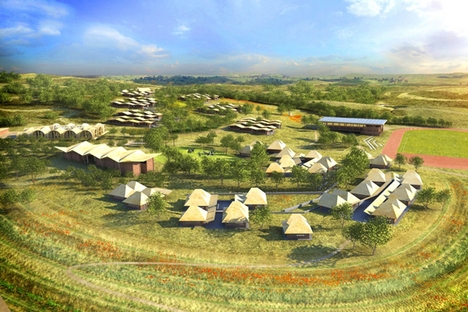
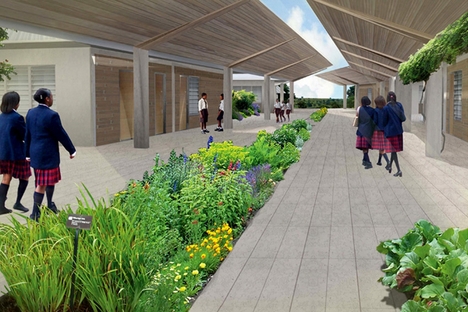
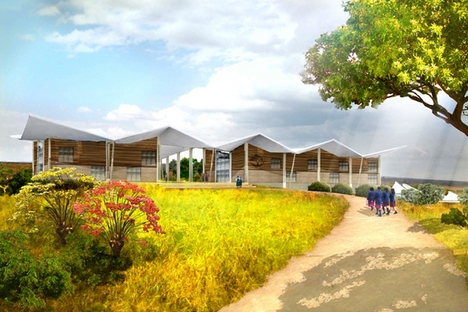
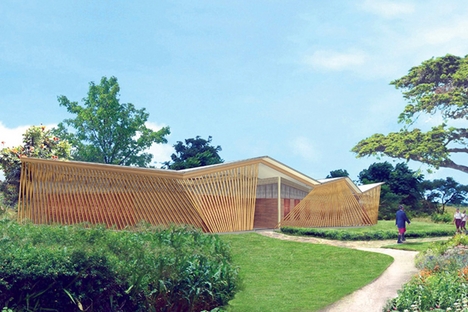
New images of a planned school in Africa being funded by Madonna have been unveiled.

The pop star is bankrolling the Academy for Girls in Malawi – the African country which her adopted son David hails from – which is currently on-site and will become a campus for 450 pupils when it is completed in two years’ time.

Monday, February 01, 2010

Abu Dhabi reveals NEW golf clubhouse


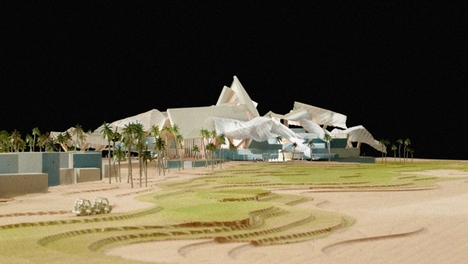
Frank Gehry-designed clubhouse for a golf course in Abu Dhabi have been revealed.

The Saadiyat Beach Golf Course has been designed by South African Gary Player and is being developed by the Abu Dhabi-based Tourism Development & Investment Company.

Covering 18,000sq m, the clubhouse will include a boutique hotel with 26 deluxe rooms as well as two restaurants, a spa and a golf shop.

Gehry said: “We are just at the beginning of the detailed design of the clubhouse and are very pleased with the progress thus far. The design is intended to be an ephemeral mirage floating above the greens.”