 Register Here for a Weekend to be INSPIRED. ENGAGED. TAKE ACTION

[Space] Conversations + Ideas That Take Place @ Our M.Squared.Designs Studios
Monday, September 26, 2011
A Decade of Designing a Muslim-American Identity


September 10, 2011 | Maryam Eskandari
This weekend, the world marks the tenth anniversary of the horrific events of September 11th. This tragedy pushed the Muslim American community to the forefront, forcing us to discover who we are, as a collective. This grueling process of defining identity can be traced through architectural designs where various attributes have been explored. From the relatively unknown Islamic inspired architecture of the World Trade Center, to the Islamic Center in Manhattan, we start to see not only a pattern of expression, but also a community coming into our own.
The World Trade Center in New York, an iconic masterpiece stood majestically around 1300 feet high. Designed by Minoru Yamasaki, an architect praised for merging modernism with Islamic architecture, recreated Mecca’s courtyard within the busy Financial District claiming the World Trade Center’s plaza was, “a Mecca, a great relief from the narrow streets and sidewalks of the surrounding Wall Street area.” Three decades ago, Yamasaki, the desired designer of the 1970’s, was commissioned for his ability to merge Islamic and postmodern design, an amalgamation of defining a renowned form of architecture. He was applauded for his innovation.

Friday, July 08, 2011
48th Annual ISNA Convention: Loving God, Loving Neighbor, Living in Harmony

Friday July 01, 2011
Islam, Pluralism and Social Harmony
Description: America finds itself at a crossroads with a financial crisis at home and war abroad. At every critical juncture in history, social movements—from civil rights to anti-war—have brought people of all races and creeds together around common values and aspirations. This session will offer reflections on the collective movement that is needed for our times, and the sacred place of love and non-violence in realizing the call for social harmony in a pluralistic society.
Speakers: Imam Feisal Abdul Rauf
Ingrid Mattson
John Esposito
Zaid Shakir
Saturday July 02, 2011
Role of Islamic Tradition in Addressing Contemporary Challenges-Conversation Between Tariq Ramadan and John Esposito
Speakers: Tariq Ramadan
John Esposito
Sunday July 03, 2011
Inclusive Mosques in the 21st Century
Description: When we create sacred spaces that affirm human dignity, we acknowledge the spiritual potential of all who enter. The inclusive mosque synthesizes our architectural legacy, recognizes the contributions of women and welcomes those seeking answers. This session presents steps to ensure mosques are places that give life to strong, loving communities that stand against injustice.
Speakers: Akel Kahera
Maryam Eskandari
Aisha Al-Adawiya
Thursday, July 07, 2011
Sacred Space: Islamic Architecture 2.0

July 1, 2011 | Illume Magazine
Maryam Eskandari interview with ILLUME Magazine
How did you become interested in architecture and why is it important?
I was introduced to architecture through my paternal grandfather. Each summer I would spend time with him in Iran, and got acquainted with the world of construction and architecture. He started off with a few lessons of drawing the living room, gradually we moved towards outdoors and by the end of the summer, he had me designing and I help him redo the interior of his house. That summer I was 15 years old and I knew I wanted to be an architect.
read more of the interview at ILLUME
Thursday, April 21, 2011
Sacred Space for Muslim Americans


Front Cover of New York's Elan magazine
Mosques have been a reason for intense debates both within the Muslim community and outside of it. Maryam Eskandari, an architect at the Aga Khan Program for Islamic Architecture at Harvard and MIT, currently has a traveling exhibit on American Mosques. She brings a new angle to the debate discussing the role of architecture as an identity issue. Her exhibit, Sacred Space: (Re)Constructing the Place of Gender in the Space of Religion is touring the nation. We sat down with the architect and artist for an interview.
How did you choose this topic for your exhibit?
This “mosque” project actually started 5 years ago when I was working on another project in Seattle Washington. It was during the holy month of Ramadan. I got an opportunity to engage with the Muslims in Seattle, in which they commissioned my firm to design their mosque. During the design process, we constantly were confronted with, allocating an accurate space for the performance of prayers. It is amazing to see how emotional people get when the issue of space is discussed. What was fascinating to see is how this particular community was able to come together during their mosque project. From my first mosque, it led me to numerous projects for the various Muslim communities throughout the States. However, one project was confronted with a huge obstacle. While we were designing, and going through case studies of various mosques in the states, we started to realize that as Muslims, we do not necessarily have an identity, an American Muslim identity, when it comes to mosques, while other countries---particularly in the Middle East do. So the questioning of identity and gender kept coming up in the design projects. That was when finally last summer; the Aga Khan Program in Islamic Architecture funded my research to visit 32 American Mosques that reside in a highly dense Muslim population across the US. However, while engaged in the project, it lead to over 100 mosques and it still continues. We were able to capture the history, space, and architecture of each mosque, along with the stories that either the community would share with us, or our own adventures that we had.
Tuesday, March 29, 2011
Bringing the Pilgrims to Qom

March 25, 2011 | Maryam Eskandari
featured in PBS|Frontline - Tehran BureauIslamic Republic's push to develop Shia holy city as a top Middle Eastern destination.
[ dispatch ] Since the early 16th century, during the Safavid dynasty, the holy city of Qom has been a significant center of Shia theological education and a locus of pilgrimage. Recently, its development has become a top priority for the Islamic Republic of Iran. Over the past eight years, Iran has been expanding Qom, not only as an "Islamic Education Center," in competition with other such cities such as Najaf, Iraq, but with the goal of making it one of the major destinations in the Middle East.
After the late 1700s, when the city flourished as a center of religious learning under Agha Mohammad Khan Qajar, little attention was paid to its development for more than century. However, in 1915, when invading Russian forces entered the nearby city of Karaj, many residents of Tehran province moved to Qom, spurring its growth into one of the region's major metropolitan areas. Consideration was even given to shifting the Iranian capital from Tehran to Qom. Over the past six years, under President Mahmoud Ahmadinejad, a vast amount of development money has been flowing into the city.
Thursday, March 17, 2011
Gender, Sexuality and Urban Spaces

This was a great, if in cohesive group of panelists. They’ve each done really interesting research on different architectural expressions of ‘women’s spaces’ in three different US institutions: contemporary Mosques, Gymnasiums at the turn of the century, and Settlement Houses in the early 1900′s.
Maryam Eskandari gave a very compelling presentation on the need to re-examine mosque typology and explore the gender hierarchy assumptions embedded in that typology. Essentially, her work has determined that mosques prioritize men’s space, making the front of the mosque inaccessible to women, and allocating the separate women’s prayer space as ½ to 1/5 the amount of space allocated to the men. She talked about radical activists in the US staging Rosa Parks-style interventions in this model. And, she advocated for the role of architects in changing the typology, making contemporary mosque design reflect the changing politics of the practice of Islam in the US where communities are more open to mixed gender prayer spaces.
follow the conference @ Gender, Sexuality and Urban Space
Libya’s Architecture on the Brink


March 7, 2011 | Maryam Eskandari
In the past couple of years, Libya has been on the forefront on cutting edge architecture. Competing with other Middle Eastern countries, such as Kingdom of Saudi Arabia, Kuwait and Qatar, Libya has been able to keep up with the “architecture boom” that has been on the rise in that region. However, several days ago, when the Security Council of the United Nation slapped a 15-0 vote sanctions on Libya in hopes to send a strong message to Libyan leader Moammar Gadhafi; many of the architectural firms stepped up to support the United Nation decision. The international firms that have on-going projects have all vowed that they would never work in Libya, under Gaddafi’s regime and have suspended all projects.
Tuesday, March 01, 2011
Tahrir Square: Social Media, Public Space: Places: Design Observer
The Mubarak government extended a series of policies initiated under Anwar Sadat. The regime supported laws and actions that sharply limited Egyptians’ access to public space — to places where citizens could congregate, meet, talk, interact. It promoted the development of gated communities with private parks, golf courses and luxury shopping malls, and in doing so facilitated the exodus of Cairo’s middle and upper classes into the desert at the city's periphery. At the same time the government ignored the city's center; its ongoing mismanagement of housing development has resulted in the extensive zone of informal housing, mostly unfinished brick shanties, that rings Cairo. And Mubarek worked to effectively dismantle and depopulate Cairo’s much-admired public squares and parks, including not just Tahrir Square but also Ramses Square and Azbakiyya Gardens. For decades, in fact, public policy and urban planning, like most governmental matters, were filtered through the harsh lens of state security. Urban open spaces — anywhere citizens might congregate and stage political demonstrations — were systematically subdivided or fenced off or given over to vehicular traffic and flyovers, and thus made challenging and even scary for pedestrians. Collectively such policies have led not only to the decline of public space but also to the inexorable deterioration of cities and the erosion of civic pride.
Read more : Tahrir Square: Social Media, Public Space: Places: Design Observer
Read more : Tahrir Square: Social Media, Public Space: Places: Design Observer
Sunday, February 20, 2011
SACRED SPACE??

read more at PBS | Frontline
Sacred Space: (Re)Constructing the Place of Gender in the Space of Religion
A Photographic Installation by Maryam Eskandari, American Iranian Architect | Artist
Opening reception: February 17, 2011, 5:30-7:30pm
On view: February 1-March 21, 2011
With 6 million observant Muslims residing in the United States, there is an ever-present demand for construction of mosques in U.S. cities. The architectural design of community mosques in the U.S. emerges as a particularly understudied problem in the aforementioned encounter between Middle Eastern architecture and American religious practice. Numerous case studies and investigations of a diverse set of mosques were conducted and studied, indicating an overwhelming majority of diverse Muslim communities across the U.S., articulating the ideal space between a “Modern Mosque” versus a “Traditional Mosque.”
All images are now part of the the Aga Khan Visual Archive.
Sponsored by: The Aga Khan Program in Islamic Architecture, Harvard and MIT Libraries, School of Architecture + Planning.
Sunday, January 23, 2011
Gehry Design Plays Fanfare for the Common Man

published in NY Times | By NICOLAI OUROUSSOFF
MIAMI BEACH — Can an architect save classical music? That seems to be what Michael Tilson Thomas, the artistic director of the New World Symphony, was counting on when he hired Frank Gehry to design him a new music center. Like others running classical music institutions today, Mr. Thomas is struggling to connect to a younger audience. The 81-year-old Mr. Gehry, who used to baby-sit for Mr. Thomas, 66, when both were living in Los Angeles, built his reputation as an architect with a knack for tapping into the popular imagination.
Read more
Monday, January 10, 2011
MIT and the art of innovation
Jan 9th 2011, 20:42 by P.M. | CAMBRIDGE, MASSACHUSETTS
WHAT is the secret of innovation? There are many explanations. “You start with some very bright people, let them hang out with other very bright people and allow their imaginations to roam,” is how Susan Hockfield, the president of the Massachusetts Institute of Technology (MIT), sums it up. But there seems to be an important local factor too.

Babbage has been along to an exhibition which has just opened at the MIT museum as part of the celebration of the institute’s 150th anniversary. Staff, students and others were asked to help pick the 150 artefacts that have been included. The idea is that these things illustrate not just some of the breakthroughs MIT has been involved with, but also the character of the institute. Some 700 nominations were made to a website and these were voted on.
read more
Monday, January 03, 2011
2010: The Year of Contentious Architecture


December 28, 2010 | Maryam Eskandari
In 2010, this year’s headlines showcased architectural projects pushing the envelope. Plagued with debate, below are the top five most controversial buildings this year.
On top of the list was none other than the Burj Dubai, renamed Burj Khalifa honoring the ruler of Abu Dhabi who spared $11 billion dollars to rescue Dubai from its financial crises. The 2,717 feet tower designed by the Chicago office of Skidmore, Owings, and Merrill (SOM) LLP, were determined to build the world’s tallest, sustainable, mixed use, and free standing structure that ever existed. On the 158th level is the world’s highest mosque, while the world’s highest swimming pool resides on the 76th floor. With barely 900 apartments now owned and only three-quarters of the 37 floors of commercial and office spaces occupied, Dubai still struggles with the rest of the $29 billion tab for the Burj. Nevertheless, what is unfortunate to see was the one-week opening of the observation deck that was forced closed because of liability and safety issues. The Burj Khalifa is still struggling to make a name for itself, while the main architects: Adrian Smith and Gordon Gill who where the designers of the Burj, upon completion, where immediately hired by the Kingdom of Saudi Arabia to design a tower, taller than the Burj Khalifa.
Read More
Read More
Tuesday, December 14, 2010
Saudi Urban Projects Are a Window to Modernity

Dec. 12 2010 | By NICOLAI OUROUSSOFF
JIDDA, Saudi Arabia — Just off a desert road about an hour’s drive from this port city, an enormous arched gate capped by three domes rises out of the sand like the set for a 1920s silent film fantasy. It is, instead, a fantasy of contemporary urban planning, the site of what one day will be King Abdullah Economic City, a 65-square-mile development at the edge of the Red Sea. With a projected population of two million, the city is a Middle Eastern version of the “special economic zones” that have flourished in places like China.
Wednesday, November 24, 2010
Redesigning Mecca


November 18, 2010 | Maryam Eskandari
Featured in New York's Elan Magazine
This last week, roughly between two to four million Muslims were honorary guests at the “House of the Divine” to fulfill a spiritual cleansing. Millions of people come each year to visit this architectural wonder, built by the father of the three monotheistic faiths of Judaism, Christianity, and Islam. They get to witness the foundation that Abraham laid, in order to build his Ummah or the society of the “Abrahamic Faiths.” This year Muslims visited the Ka’aba, before it goes under heavy renovation by two of Britain’s “starchitects”: Norman Foster and Zaha Hadid.
Sunday, November 07, 2010
Why Park51 is much more than the 'mosque at Ground Zero'
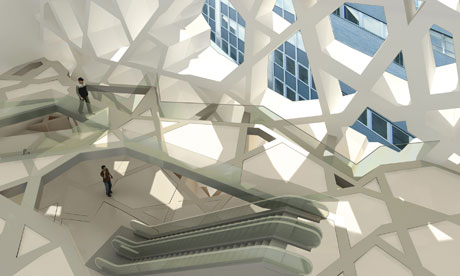
The Observer, Rowan Moore
It's easier to say what the "mosque at Ground Zero" is not, than what it is. It's not a mosque, and it's not at Ground Zero – only nearby. It's not a "clubhouse for terrorists", as some objectors have called it, nor a work of "triumphalist stealth jihad". It does not "loom" over the "hallowed ground" of the 9/11 attacks, which cannot be seen from its site.
As to what it is, the explanation is not at first very enlightening. Park51, to use the project's proper name, is "a friendly and accessible platform" that "enriches lower Manhattan in body and spirit, with ecologically conscious design and operation". However, its architect, Michel Abboud, makes things clearer: it is a Muslim version of the YMCA, or the many Jewish community centres in New York. That is, it will have a swimming pool, basketball court, childcare and exhibition facilities, a library, auditorium, restaurant and catering school. As with the Christian and Jewish versions, you won't have to be a believer to use these facilities.
The Green Mosque


November 2, 2o10 | Maryam Eskandari
Featured in New York's Elan Magazine
Last week, the Chicago based nonprofit organization, Faith in Place, announced its winner for “Building: Problem or Solution?” competition. 26 design firms, representing 11 states, and six countries participated. Of which, the winner for this year was a team of four young Muslims, from Pasadena, California whose winning entry was the Sustainable Green Mosque. The Sustainable Green Mosque played on the notion of weaving the sustainability concept, along with the traditional mosque elements, into a modern urban context.
Zaha Hadid’s Chanel Pavilion


October 19, 2010| Maryam Eskandari
Featured in New York's Elan Magazine
Read More
Sand Dunes of China


Oct 10, 2010| Maryam Eskandari
featured in New York's Elan Magazine
This year, Aladdin and his 1001 night’s stories somehow ended up looking for the genie’s lamp in the heart of one of the most architecturally congested cities of the world, Shanghai. Unless, you where busy trying to get your three wishes, you know that this summer was one of the most hyper active summers, where the whole world got together. Despite the fact that Hollywood tried to do us a favor and take us to Iran, with the Prince of Persia, to Abu Dhabi with Sex and the City or the whole world watching South Africa for the World Cup; China just decided to bring the whole world to its back yard with the World Expo. Of which, United Arab Emirates (UAE) audaciously gave a big pile of sand to be displayed.
Subscribe to:
Posts (Atom)